
 Ricardo Pinto
We live in a world filled by human achievement in science, technology, and industry. Yet, instead of admiration, progress often meets culture-wide suspicion or attack. What explains this response?
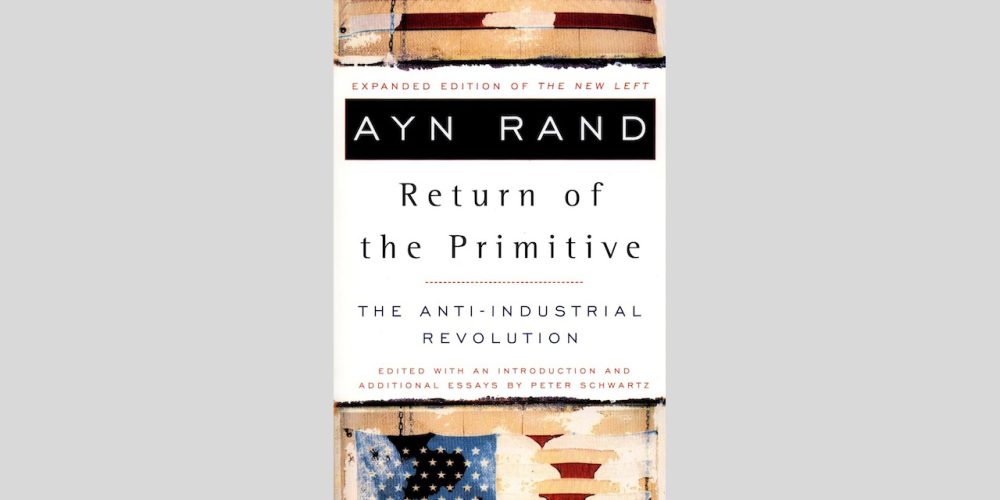
Ayn Rand offers an answer in her essay “The Age of Envy.” Originally anthologized in her book The Return of the Primitive: The Anti-Industrial Revolution, and now available online for the first time, she argues that hostility to values more generally is nothing less than the defining spirit of our time.
What is this spirit? Rand calls it “hatred of the good for being the good.” It is a drive not to attain the good but to punish and destroy it. Once this motive is named, it can be seen everywhere in the culture, from classrooms to boardrooms.
As one illustration, Rand draws a striking contrast between early conceptions of socialism and modern egalitarianism. However evil and destructive in practice, socialism at least pretended to aim at raising the standard of living for all. By contrast, today’s egalitarians show little interest in achievement or production, seeking instead to level all distinctions, rejoicing in the downfall of the successful. Rand goes on to show how other modern ideologies, such as multiculturalism and environmentalism, are manifestations of the same underlying psychology.
What is the underlying psychology? Rand traces it to a troubled relationship with self-esteem, in which the sight of achievement is experienced not as an inspiration but as something to resent or evade.
A culture driven by hostility to the good demands explanation. Read “The Age of Envy” to see how she accounts for it.
Find a passage from the beginning of the article below.
A culture, like an individual, has a sense of life or, rather, the equivalent of a sense of life — an emotional atmosphere created by its dominant philosophy, by its view of man and of existence. This emotional atmosphere represents a culture’s dominant values and serves as the leitmotif of a given age, setting its trends and its style.
Thus Western civilization had an Age of Reason and an Age of Enlightenment. In those periods, the quest for reason and enlightenment was the dominant intellectual drive and created a corresponding emotional atmosphere that fostered these values.
Today, we live in the Age of Envy.
“Envy” is not the emotion I have in mind, but it is the clearest manifestation of an emotion that has remained nameless; it is the only element of a complex emotional sum that men have permitted themselves to identify.
Continue reading the essay here, or find it in Rand’s book Return of the Primitive: The Anti-Industrial Revolution.

 Gregory Salmieri