


Since September 11, 2001, the Ayn Rand Institute has commented extensively (via articles, books, interviews, lectures, and podcasts) on why the 9/11 attacks happened, how America should have responded, and why — 25 years and three wars later — the United States still fails to confront Islamic totalitarianism.
ARI’s analysis of 9/11 and its aftermath has proven tragically accurate. To mark 25 years since the attacks, we are pleased to announce the publication of the third, expanded edition of Failing to Confront Islamic Totalitarianism, which includes short essays on October 7 and the war in Iran, and we invite you to join us for two special events.
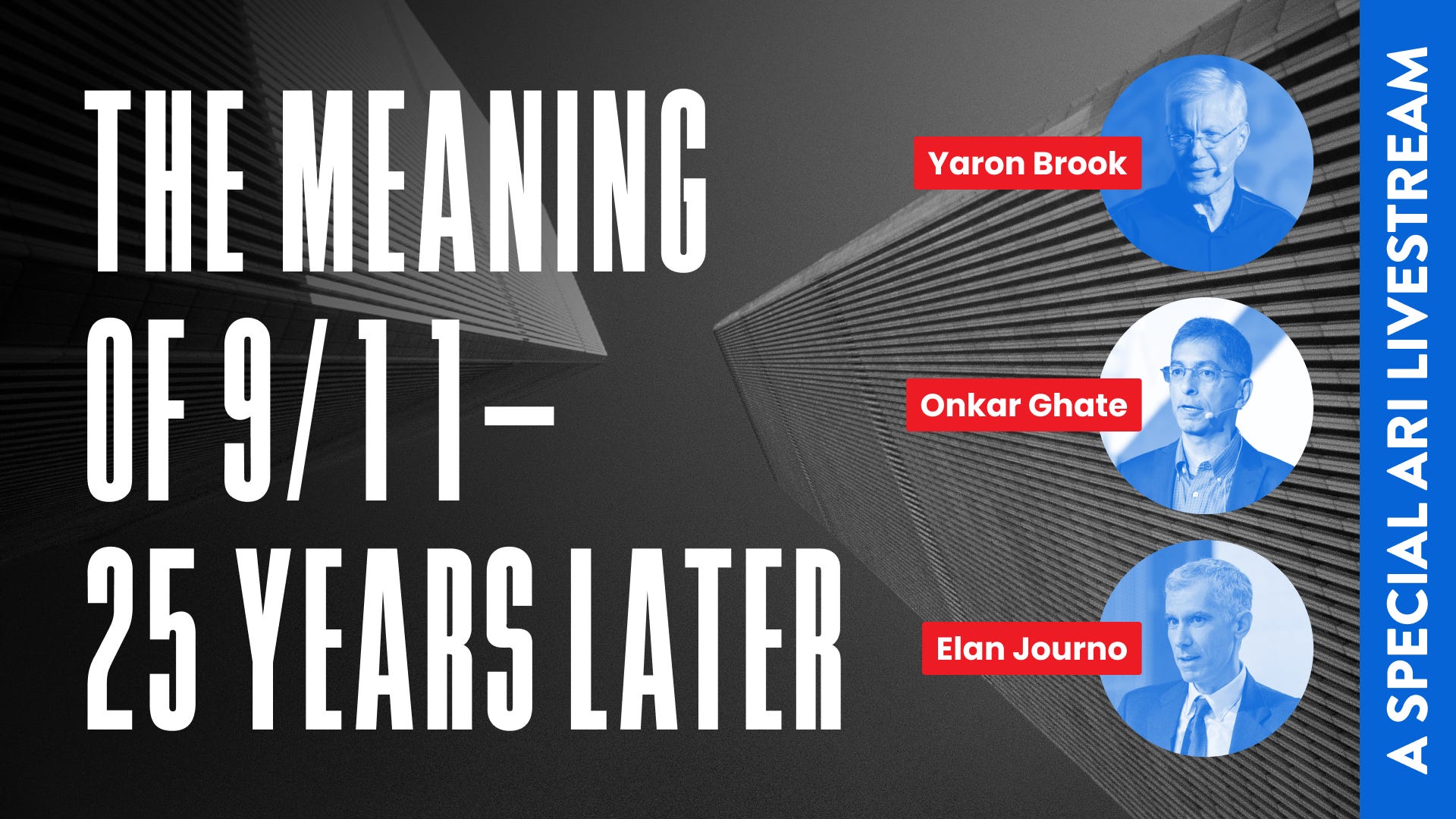
On September 2, 2026, we will host a live broadcast of the Ayn Rand Institute podcast on the meaning and impact of 9/11 with Yaron Brook, Elan Journo, and Onkar Ghate, the Institute’s three leading experts on these issues.
On September 11, 2026, we will livestream lectures on 9/11 by Onkar Ghate and Elan Journo from our U.S. student conference in Austin.
To watch these livestreams — and to receive a free digital copy of the new third edition of Failing to Confront Islamic Totalitarianism — please register here.
Below you’ll find the preface to the book’s new edition.
Preface to the Third Edition of Failing to Confront Islamic Totalitarianism: What Went Wrong After 9/11
On August 15, 2021, the Taliban walked into Kabul. While American military planes evacuated from Hamid Karzai International Airport, frantic Afghans ran along the tarmac, clinging desperately to the fuselage and landing gear; as one of the aircraft left the ground, some fell to their deaths. After twenty years of war, trillions of dollars, and thousands of lives, America had let the jihadists return to power, triumphant.
The self-delusion in Washington reached a new nadir. The world’s superpower had failed to defeat a vastly weaker enemy, but President Joe Biden described the humiliating American withdrawal as an “extraordinary success.” Apologists told us that the Taliban, which had hosted the 9/11 planners, had “moderated,” even as they re-imposed religious control and the subjugation of women.
The Afghanistan retreat, echoing the Fall of Saigon in 1975, was another ignominious effect of the fundamental problem subverting American foreign policy. This book exposes that problem: the influence of irrational philosophic ideas, which led to the persistent evasion of the enemy’s nature and the lack of moral clarity America needs to act assertively in its self-defense.
The intellectual-moral weakness of America, and of other free societies, encourages the Islamist movement. At its peak, the Islamic State established a “caliphate,” in parts of Syria and Iraq, that attracted thousands of zealous recruits from North America and Europe. From its stronghold, the Islamic State directly and indirectly inspired attacks in Paris, Orlando, and Manchester. Even after its collapse, jihadists attempted to carry out murderous attacks: the Salman Rushdie stabbing in Chautauqua, New York (2022), the plot targeting Taylor Swift concerts in Vienna, Austria (2024), and the deadly shooting spree at Bondi Beach, in Sydney, Australia (2025).
But the most significant jihadist attack since this book’s last edition was the air, sea, and land assault from the Hamas-governed Gaza Strip into southern Israel on October 7, 2023. Palestinians loyal to Hamas massacred some 1,200 people in a single day and seized 251 more as hostages. The killers gleefully filmed themselves committing atrocities.
The reaction to October 7 in the United States, Canada, and Europe was itself revealing. During a livestream podcast on October 7, one of us (Elan) predicted that the world’s immediate sympathy would give way to accusations of Israeli war crimes, once the conflict stalemated or otherwise resolved. That prediction was partly wrong; the sympathy lasted not weeks but mere hours.
By the next morning, a statement co-signed by some thirty student groups at Harvard University had gone viral. These students held “the Israeli regime entirely responsible for all unfolding violence.” Mass rallies soon clogged the streets of major cities and world capitals. Student protests brought universities to a standstill. Demonstrators shut down roads and bridges.
Hamas called its invasion the al Aqsa Flood. Another morally obscene deluge poured into the streets of major cities and the campuses of elite universities in the West, where activists blamed the Israeli victims and whitewashed their Palestinian murderers.
The October 7 backlash affirmed the wider theme of this book: the fundamental role of philosophic ideas in shaping culture (and thus foreign policy). The widespread unwillingness to face Hamas’s Islamist nature has to be understood in the context of two decades of intellectuals and politicians evading that religious ideology and enforcing a taboo on any discussion of it. This evasion was a signature policy of George W. Bush, who insisted that the 9/11 killers had “hijacked” Islam, that it was a religion of “peace.” A second, deeper contributing factor: the anti-freedom, anti-capitalist, anti-individualist ideas that universities have been inculcating for generations. (Here, one positive sign that we wrote about was the decision of prominent donors to withdraw their funding from universities in protest. See Part 7.)
The third major development since the last edition is enormously consequential, but also (at the time of writing) unresolved. On February 28, 2026, the United States and Israel went to war against the Islamic Republic of Iran.
For reasons identified in Dr. Leonard Peikoff’s essay “End States Who Sponsor Terrorism” and in our writings that follow, we regard an American war with Iran as a retaliatory act: a war of self-defense, decades overdue.
Predictably, however, this war has been fought without a clear objective. The proclaimed goals kept changing. A partial list:
eliminate “imminent threats” from Iran and prevent it from gaining nuclear weapons (February 28, 2026);
“destroy the missile threat, destroy the navy, no nukes” (Hegseth; March 2, 2026);
“unconditional surrender” (Trump; March 6, 2026) to be determined not by the facts, but Trump’s say so;
victory had occurred already in Trump’s view (March 7, 2026), so “We don’t need people [i.e., NATO allies] that join Wars after we’ve already won”;
degrade Iran’s missile and nuclear capability, which Trump insisted after a 2025 bombing had been “obliterated”; on March 14, 2026, Trump stated that “We have already destroyed 100% of Iran’s military capability” even as the regime continued fighting back;
“regime change” was a goal that Trump took credit for, with the killing of key Iranian leaders, but also claimed wasn’t the goal (April 21, 2026);
a diplomatic bargain to prevent an Iranian nuclear weapon (2025; throughout Feb–May 2026) for which Trump was willing to negotiate with the Iranians, granting the regime what the Obama deal had likewise conceded: an undeserved moral legitimacy.
The administration failed to provide a coherent justification for the war and refused to seek congressional approval for it, violating the rule of law. As the president told one audience on March 25, 2026, “I won’t use the word ‘war’ because they say, if you use the word ‘war,’ that’s maybe not a good thing to do,” adding: “They don’t like the word ‘war,’ because you’re supposed to get approval, so I’ll use the word ‘military operation,’ which is really what it is.” Bothered by unfavorable media coverage of the war, Trump’s FCC chairman threatened to revoke the licenses of TV networks, violating the First Amendment.
Early on, Trump told the New York Times, “What we did in Venezuela, I think, is the perfect, the perfect scenario” for Iran. This was a reference to the forcible U.S. removal of Nicholas Maduro from power, leaving his cowed subordinates to govern under American oversight. Whereas Venezuela is run by thugs and gangsters, Iran is an ideologically driven regime. Failing to recognize that reality has been a central flaw in the Iran war.
The war’s conclusion remains to be seen. Clearly, the elimination of key leaders and the significant degradation of Iranian military capabilities are worthy accomplishments. By the April ceasefire, however, the regime had (predictably) seized the Straits of Hormuz to strangle the flow of cargo ships carrying oil. One major risk is that the war ends in a stalemate, which given our military superiority, would mean an American defeat. For the Iranian regime, surviving this war is a kind of victory.
Moreover, permitting Iran to exact tolls on ships in the Straits of Hormuz means affording it a new revenue source to fund its militant agenda. And a diplomatic agreement fixated on nuclear weapons capability — which appears to be an aim of the Trump administration — would be a regression to the Obama-era evasion of the regime’s Islamist nature, its sponsorship of jihadists, and its manifold other forms of aggression.
Unless Iran’s ideological goal is shown to be a lost cause, unless it and other Islamists are demoralized, unless they lose all hope of realizing their nihilistic agenda, we can expect the Iranian regime (and other jihadists) to seek to resume their holy war. That was one lesson of Israel’s disastrous “mowing the grass” policy in Gaza. A degraded but undefeated Hamas rebuilt and resumed the fight on October 7.
We published the first edition of this book in 2016, and the second, in 2021 during the Afghanistan withdrawal. Now, a quarter-century on from the 9/11 attacks, we issue a third. Our philosophic analysis has been proven correct, and we believe it needs to be heard.
Here briefly is the argument: The fundamental obstacle to defeating Islamic totalitarianism is not a deficit of military capability. The problem is philosophic. The prevailing moral idea of self-sacrifice has negated American self-confidence, and it has crippled the ability of our leaders and intellectuals to conceptualize the enemy and to define and pursue our self-interest. Irrational philosophic ideas have subverted the world’s greatest military force.
But we remain convinced that ending the Islamist menace is achievable — if the United States adopts, understands, and consistently acts on rational moral ideals.
***
Added to this edition are seven short essays on: the Afghanistan retreat; the 2022 “Woman, Life, Freedom” protests in Iran; the October 7 attacks and their aftermath; and the Iran war’s early phase. Also added as an afterword is an interview about ARI’s response to 9/11, why it was so important for the Institute to engage on this issue, and how our distinctive analysis is informed by the philosophy of Objectivism. Removed from this edition are lists of resources that can be found online.
To keep up with ARI’s ongoing intellectual work — podcasts, essays, books, and more — subscribe to email updates from our journal, New Ideal.
***
Finally, we wish to thank ARI’s donors for their support of the philosophic ideals that we hold in common, and for making possible our work on this crucial issue. We are grateful for their dedication to the Institute’s mission of advancing Objectivism. Special thanks to Jay Snider, for generous funding through his family foundations, and to Larry Berkelhammer, for his encouragement and generous support of our research and writing.
Elan Journo
Onkar Ghate
June 2, 2026