

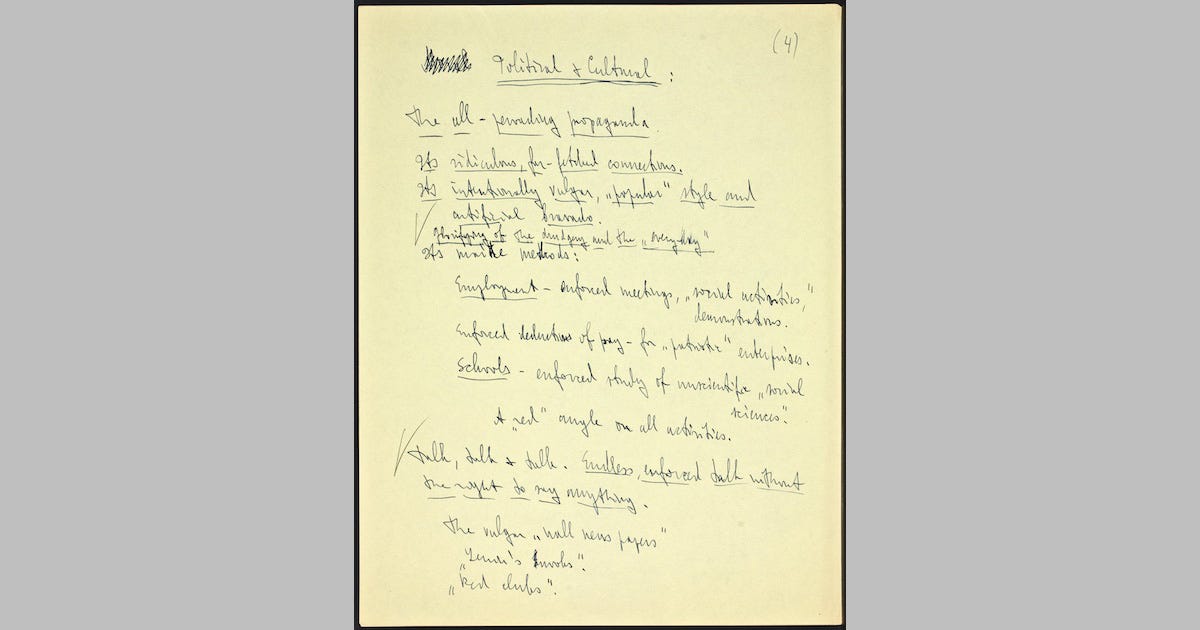
Over the next few years, interested users around the world will get an increasingly complete picture of how Ayn Rand developed as a thinker and writer over time. Facilitating this opportunity is the Ayn Rand Archives’ ongoing effort to digitize, transcribe, and release Ayn Rand’s manuscripts on the public internet.
Ayn Rand’s handwritten material is not easy to read. Much of it is in cursive, a writing style that fewer and fewer people learn how to read. Even for those who can read cursive, her unique penmanship can still be a challenge, as many pages of material in her personal papers were notes or drafts never intended to be legible to anyone other than herself. Therefore, just putting the scans of these pages online would not achieve the Ayn Rand Archives’ goal of making this material globally accessible.
For that, we needed to add something: typed transcripts.
Transcripts, typed copies of the handwritten words on the page, truly unlock Ayn Rand’s archival materials. Our goal is to make these transcripts as accurate as possible to Rand’s original words.
Transcription notation
While there are some limitations on this in any given typed format, our current transcription platform allows us to get very close to the originals using various formatting conventions.
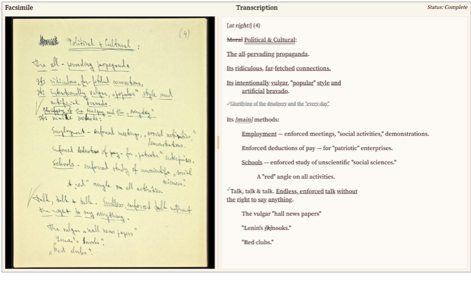
The following examples are taken from this page (shown above), this page, and this page, all part of Rand’s planning material for her first novel, We the Living.
Broadly, we have attempted to match what we see on the handwritten page in the typed version. This includes line and paragraph breaks, check marks or other symbols, a certain amount of left indentation, underlines, and deletions or strikethroughs.
Deletions
For readability, these last are always represented as strikethroughs in the transcript, even if Rand used heavier markings:


Insertions
These later additions made by Rand are presented as smaller, superscripted text in the transcripts:


Uncertain Words
When the handwriting is unclear but a reasonable guess is possible, the platform presents the word in brackets, with both the word and brackets italicized.


Regularization
In some cases, Rand either misspelled a word or name or used a less common spelling of something. These words are regularized in the transcript, meaning that the correct or common spelling is given. These are presented in italicized text with a dashed underline. Hovering over these words reveals the original spelling or phrasing as it appeared in Rand’s handwriting, which allows for improved reading and searching while still providing an accurate representation of the original.


Other regularization used throughout all transcripts (which is not formatted):
Rand used a version of the plus sign (+) for an “and” symbol; the transcripts regularize this to the ampersand (&) symbol in order to be more machine-readable.


Quotation marks are in the standard American English convention, with both opening and closing quotation marks appearing at the top of the word (“abc” or ‘abc’); Rand herself switched to this convention later in her life, but in much of her early writing (as seen above) she used the European convention of a lower opening quotation mark that appeared at the bottom of the word.
Nonstandard elements
Some elements of the handwritten text cannot easily be reproduced through formatting within this platform, or are otherwise best handled via transcriber notes, short, written descriptions of something on the original page. These are given as italicized comments within regular brackets:


Searchability
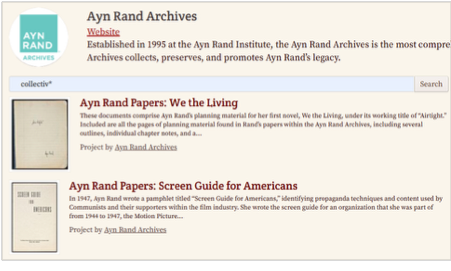
One of the biggest benefits of these transcripts is that they are full-text searchable. Anyone can read through the complete text of this archival material, but that is not necessary to find material of interest. Keyword searches, with or without a wild card (*), are possible.

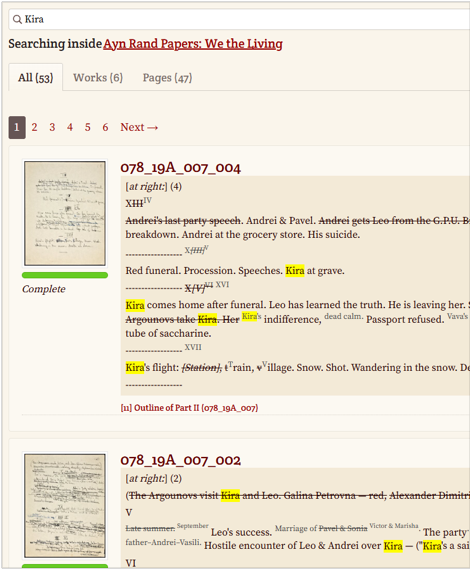
Searches can be conducted within a particular set of Ayn Rand’s papers, such as just within her We the Living material:
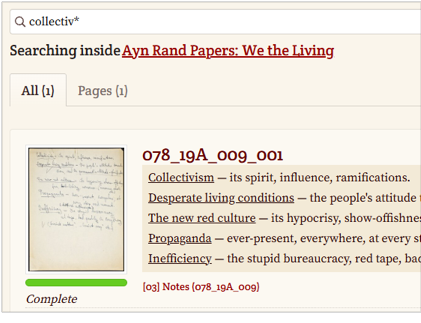
But they can also be conducted on all the publicly available archival materials within our transcription platform:
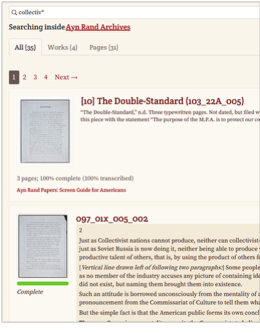
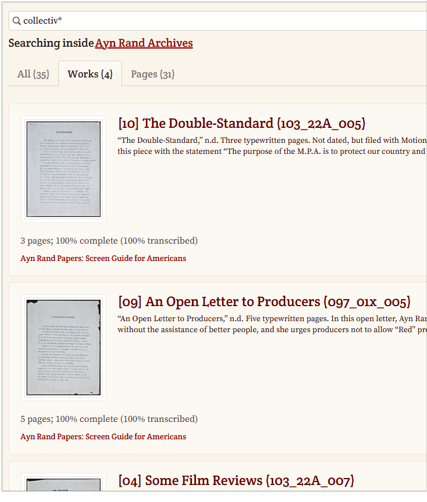
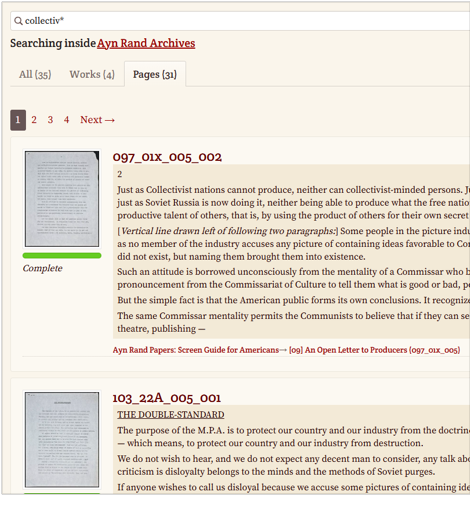
Within the search results, users can look at “Works” (whole documents) that contain the search keyword, or they can look at individual pages which contain the keyword:
This search will become more powerful as we continue to release more of Rand’s archival material. Thanks to the power of these digital tools, this resource is not limited to a particular physical location of the Archives, but rather is accessible to anyone with an internet connection.
We are deeply grateful to our volunteer transcribers, whose efforts have made this entire project possible.
For any questions about the archival material available through this platform, or for more information about how to become a volunteer transcriber, please contact [email protected].
Audra, thank you for taking this on — I'm glad you're on the case.
Anyone who follows Rand's reception knows how routinely she's misquoted and misrepresented. Accurate, searchable digital texts are the fastest way to settle those arguments: instead of arguing about what she said, you can point to it.
This may turn out to be the most significant boost to the reach of her ideas in years.
“Unlocked”… is that you, ChatGPT?