


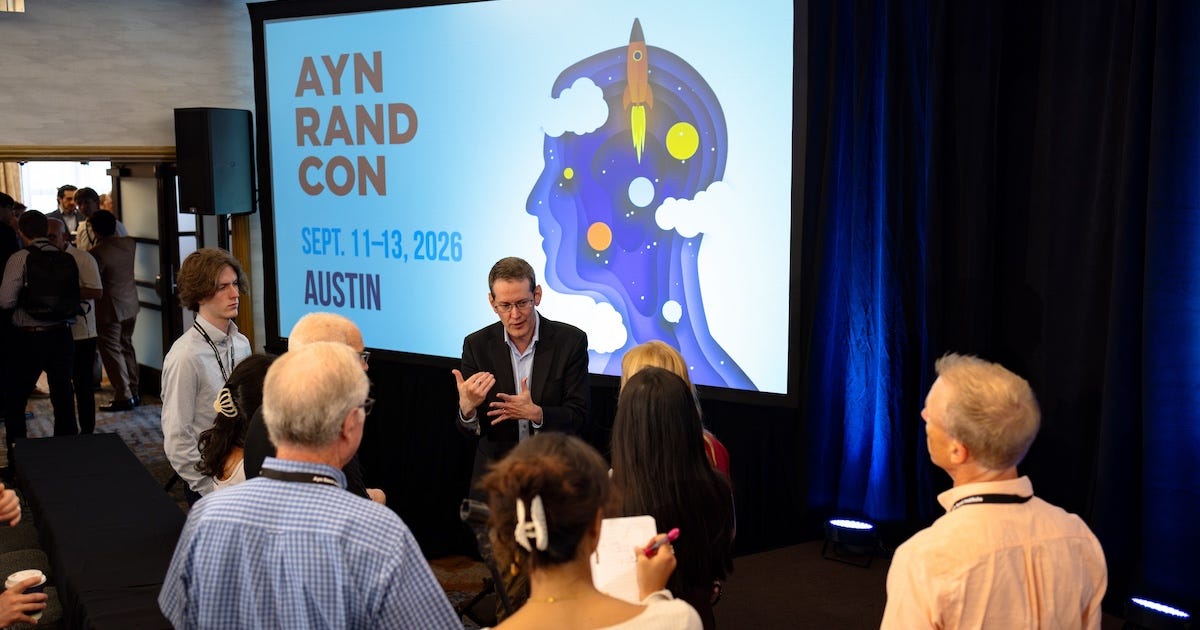
Last month, Ayn Rand fans from across the world gathered in Austin, Texas for AynRandCon US, ARI’s annual US student conference. Among them were 67 scholarship students from 16 countries. For many of them, it was their first encounter with Ayn Rand’s ideas beyond her novels — and their first chance to meet Objectivist intellectuals and fellow Ayn Rand fans. Across three days, the program combined lectures and Q&A sessions with long breaks for mingling with faculty and other attendees, as well as an evening reception and a social event.
The conference kicked off on the evening marking 25 years since 9/11, with Onkar Ghate and Elan Journo examining America’s failures before and after the attacks. Their talks drew on more than two decades of expertise in the subject and were livestreamed on YouTube.
Ben Bayer opened the second day of the conference with a lecture on the morality of capitalism. He argued that industrial and commercial activities demand the same exalted dedication to truth and integrity as intellectual pursuits protected by the First Amendment — and thus they also deserve to be protected by right. Onkar Ghate followed with a talk focused on reason vs. faith, explaining why people follow religion and why only a philosophy of reason can provide the values that the better minds among them are searching for. Then, a panel discussion with Ghate, Bayer, Journo, and Tal Tsfany explored the value of intellectual careers, encouraged students to consider them, and promoted study at ARU and training at ARI’s Intellectual Incubator.
On the final day of the conference, Greg Salmieri explored how Ayn Rand’s ethics of selfishness helps us build a life of reason, purpose, and self-esteem, allowing one to grow up philosophically and move beyond faith-based moral codes. Tal Tsfany followed him and offered practical tools for self-discovery and the creation of a passionate, individualized life. Sealing the conference, Harry Binswanger presented the Objectivist view of free will, explaining how it works and why it is at the root of Objectivism’s approach to reason, individualism, political freedom, and romanticism.
Following the conference, one of the students wrote that she now knows “that there are interesting, intelligent, wonderful students and professors of Objectivism and that that community exists and has myriad opportunities to engage in as a student, attendee, professional, etc.” Another commented that “more than anything, I left the conference with a clearer sense of direction and a renewed desire to make the most out of my life.” Both enrolled at ARU after the conference, as a number of other students did. Other students said they are interested in engaging more with ARI through the Institute’s online content, while considering or preparing to apply to ARU.
Faculty members were enthusiastic as well. Bayer, who has spoken at many ARI conferences, said that “this is probably the most exciting student-oriented Objectivist conference I’ve attended. Our engagement team worked overtime to select the most curious and intellectually serious students to attend ARU. The conversations I had with them — both in Q&A sessions and between sessions — showed the fruit of their efforts. I was peppered with questions on a huge range of topics, both theoretical and applied. And I’ve been encouraged to learn that many of these students are now applying to ARU. I can’t wait for our conversations to continue into the fall and spring in our new Intensive seminar.”
Reflecting on the conference success, Brian Alspach, ARI’s director of engagement, said that “looking forward, AynRandCon will continue to play a central role in ARI’s strategy as we work to attract and engage students with future intellectual potential.”
If you wish to attend a future AynRandCon, registration and scholarship applications are now open for AynRandCon Europe, which will take place in Vienna on April 16–18, 2027.