


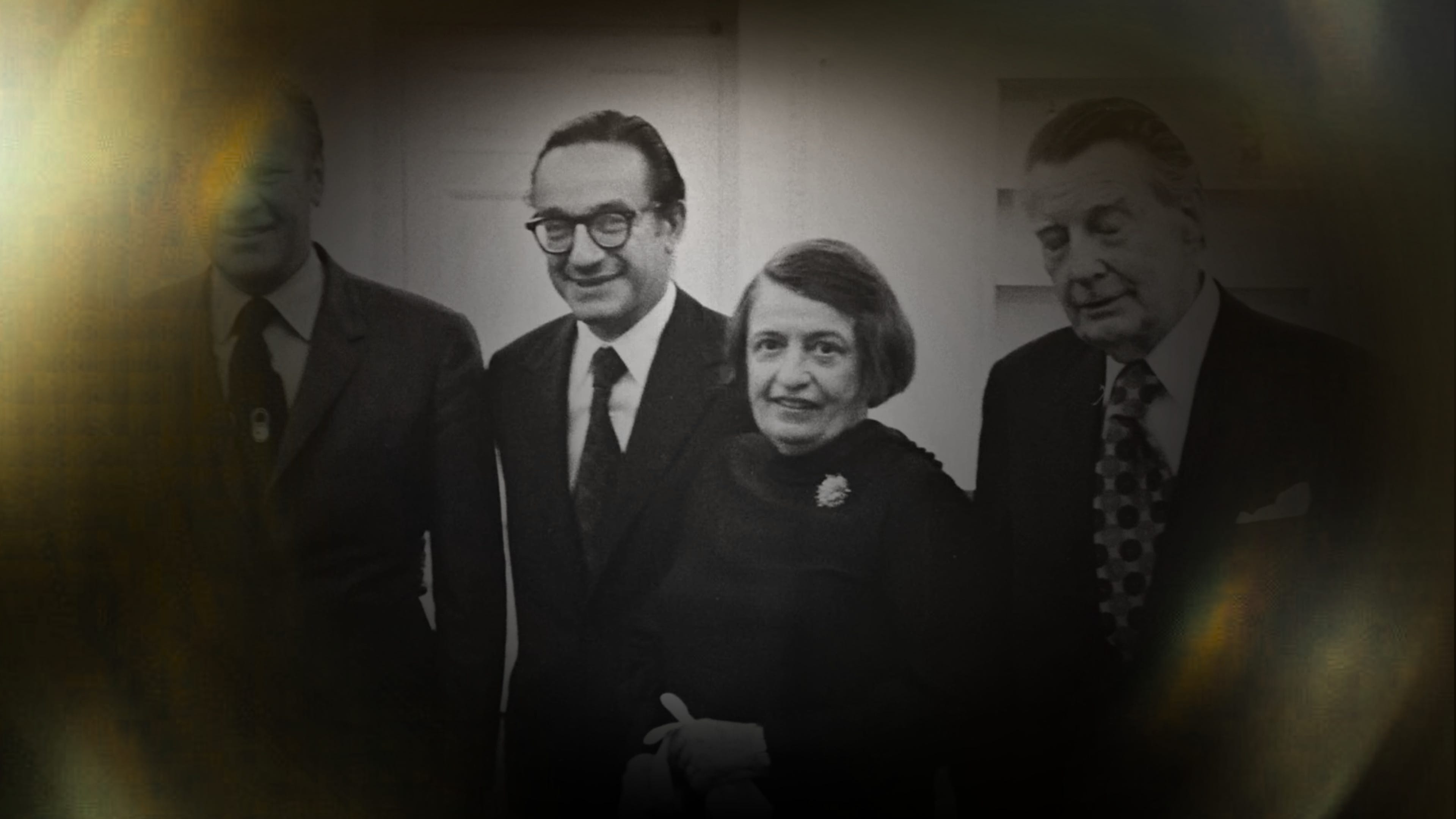
The legacy of Alan Greenspan, the second-longest tenured chairman of the Federal Reserve, has been a source of controversy for decades. His association with another controversial figure, Ayn Rand, has drawn particular scrutiny.
During his lifetime and after his death on June 22, 2026, some hailed him as an economic “maestro,” while others blamed him for causing the 2008 financial crisis. One narrative continues to resurface by his critics: Because Greenspan was once an associate of Ayn Rand, the policies he pursued during his tenure at the Federal Reserve must have represented her ideas in practice. His alleged failures, therefore, reflect on Rand’s ideas: Those ideas must be erroneous. Or so the story goes.
Following Greenspan’s death, financial journalist Roger Lowenstein wrote in the New York Times that “no one had championed the free-market system or worked to block financial regulation” with more ardor than Greenspan.1 In his article, Lowenstein portrays Greenspan as still operating from principles he had learned from Rand when the 2008 financial crisis struck. On Lowenstein’s account, Greenspan’s 2008 congressional testimony amounted to a longtime adherent of Rand conceding that those principles had been wrong. Charges like these are nothing new. Writing in Time back in 2009, Andrea Sachs called Greenspan Rand’s “most famous former acolyte,” who “has been blamed for inflating the housing bubble by refusing to intervene in the market.”2
Despite these repeated claims, Greenspan’s own words provide the strongest evidence against the idea that his career in government represented Ayn Rand’s philosophy — Objectivism — in practice. In his 2007 memoir, Greenspan portrayed his early enthusiasm for Rand’s ideas as something that gradually gave way to doubts. The significance of that change becomes especially clear when one examines the ideas Greenspan had originally defended.
Greenspan’s early advocacy of free-market principles
Commentators have reason to draw a connection between Rand’s pro-capitalist ideas and Greenspan. Greenspan was a member of Rand’s inner circle during the 1950s and 1960s and taught a course titled Economics of a Free Society at the Nathaniel Branden Institute.3 Three of Greenspan’s essays, published under Rand’s editorship and with her approval, were anthologized in Capitalism: The Unknown Ideal, in which Rand laid out her moral defense of laissez-faire.4
At this time in the 1960s, Greenspan agreed with Rand: He advocated a free-market monetary system and opposed central banking. Under capitalism, the only moral function of government is the protection of individual rights. This calls for a complete separation between state and economics, as between state and church.5 It includes a separation between state and banking.
Decisions about banking, money, and credit are made privately, through voluntary exchange rather than government coercion. Government officials have no power to regulate banks or control the money supply. Greenspan himself had made that case in “Gold and Economic Freedom,” writing that “under the gold standard, a free banking system stands as the protector of an economy’s stability and balanced growth.”6
Greenspan also made the case in that article that the Federal Reserve helped precipitate the Great Depression. He argued that central banking itself, by placing control of money and credit in government hands, would inevitably result in market distortions, periodic downturns, and calamities on the scale of the Great Depression.
On this issue, Greenspan’s position clearly reflected ideas Rand herself held: She published “Gold and Economic Freedom” in her own book.7 In the introduction, Rand spoke for all the book’s contributors, Greenspan included, when she described “our approach.”
There is no evidence that Rand ever changed her view that laissez-faire capitalism demands a fully free, private banking system. For instance, in 1974, she criticized the policy of issuing fiat currency (currency backed by government force, not goods like gold). She argued that fiat money makes possible deficit financing, thereby enabling the redistributive welfare state, causing inflation that erodes producers’ savings and destroys economic progress.8 She had already expressed her opposition to fiat currency in Atlas Shrugged, where Francisco d’Anconia’s famous money speech refers to “pieces of paper, which should have been gold.”9
Putting these laissez-faire capitalist ideas into practice would require radically changing the government’s role in the economy. Greenspan wrote in his memoir that his aim in entering politics was “to advance free-market capitalism as an insider.”10 In 1968, while continuing his private economic consulting work, he served as the “principal economic advisor” for Richard Nixon’s presidential campaign.11
Then in 1974, Greenspan became chairman of the Council of Economic Advisers, nominated by Nixon and sworn in under President Gerald Ford. The council is an advisory body “charged with offering the President objective economic advice” on domestic and international policy.12 Rand attended his swearing-in and endorsed his appointment, stating, “I’m very proud of Alan. . . . His is a heroic undertaking.”13
What was Greenspan trying to accomplish at the Fed?
Rand’s endorsement in 1974 should not, however, be treated as support for Greenspan’s decision to become chairman of the Federal Reserve in 1987, five years after her death. The Federal Reserve was created, as Greenspan observed in 1966, to alleviate alleged problems in a free, capitalist banking system — and then proceeded to help usher in the Great Depression. The chairmanship Greenspan accepted in 1987 was, therefore, quite different from his earlier advisory roles, where he was (or should have been) advising government on how to de-control.
It is worth noting that in her essay “The Question of Scholarships,” Rand wrote that one should not accept “any job in a regulatory administrative agency enforcing improper, non-objective laws.”14 But that essay does not necessarily settle the question of whether an advocate of free banking could properly accept the chairmanship of the Federal Reserve. The essay also states that “it is proper to take the kind of work which is not wrong per se, except that the government should not be doing it, such as medical services.” Arguably, this includes banking services, which need to be provided even when government takes over large parts of the field.
But according to Rand, you may take a government position in an industry that should be private “so long as you fight against welfare statism (and only so long as you fight it).” This suggests that one could only take the position of Fed chair by advocating an end to the Fed and working to free the banking industry.
Indeed, in other essays, Rand supported transitional measures in sectors of the economy that should ultimately be freed from government control. In 1973, for example, she proposed tax credits for education as “a step in the right direction” in “a disastrously mixed economy, which cannot be freed overnight.”15 She also supported a temporary “fairness doctrine” in public higher education, a system she otherwise opposed, in order to prevent government-sponsored intellectual cliques from monopolizing the nation’s colleges.16
The relevant question, then, is what Greenspan was actually trying to accomplish at the Fed. Anyone who portrays his tenure as Rand’s ideas in practice would need to show that his policies reflected those ideas. For instance, one would have to show that he used his position to help advocate ending the Fed, and enabling a transition to a policy of free banking. The critics cited above offer no evidence that Greenspan did anything of the sort.
Taking Greenspan at his word
Those who advance the idea that Greenspan was a devoted Rand disciple well into the 21st century sometimes point out that Greenspan continued to speak of Rand with admiration. In 2000, Greenspan stated that he still thought that Rand “was right” and had “learned a great deal from her.”17 Such statements raise an obvious question, though: right about what? His general statement about Rand’s influence is not proof that he actually implemented or even tried to implement any of her political or economic ideas. In fact, his own words serve as a meaningful counterpoint to such claims.
In his memoir, Greenspan recalls that “contradictions inherent in my new notions” had begun to trouble him. The only example he gives of such “contradictions” is Rand’s proposal that government in a free society must be financed voluntarily. Greenspan says he regards her explanation as inadequate. He goes on to say that although he continued to regard free-market competition as generally “compelling,” if there were “qualifications” to his intellectual framework, he could not expect others to accept it.18
Across Greenspan’s decades-long political career, there is no evidence that he used his position to advocate eventually abolishing the Federal Reserve or transitioning monetary policy toward the free banking system he had advocated in the 1960s. Nor is there any statement of his suggesting that he treated his position as an opportunity to apply Objectivist principles to governance. For those who claim otherwise, it is not enough to show that Greenspan was once influenced by Rand or that she endorsed his appointment to an advisory position in 1974. To treat his later career at the Federal Reserve as the application of Objectivism requires evidence that Greenspan’s actions were actually guided by Rand’s ideas. His own account points in a very different direction.
It is right to try to understand Greenspan’s legacy and contradictions. But to attribute Greenspan’s policies to Ayn Rand is a distortion of the historical record.
Image credit: David Hume Kennerly/Hulton Archive via Getty Images
Roger Lowenstein, “Alan Greenspan Was Wrong About One Thing. It Was a Big One,” New York Times, June 22, 2026, https://www.nytimes.com/2026/06/22/opinion/alan-greenspan-federal-reserve.html.
Andrea Sachs, “Ayn Rand: Extremist or Visionary?,” Time, October 12, 2009, https://content.time.com/time/subscriber/article/0,33009,1927269-1,00.html. For more examples of this narrative, see Joseph E. Stiglitz, “Capitalist Fools,” Vanity Fair, January 2009, https://www.vanityfair.com/news/2009/01/stiglitz200901-2; Jennifer Burns, Goddess of the Market: Ayn Rand and the American Right (New York: Oxford University Press, 2009), 283.
At the time, Nathaniel Branden was a close associate of Ayn Rand and coeditor of The Objectivist Newsletter and later The Objectivist. He founded the Nathaniel Branden Institute to offer lecture courses on her philosophy, Objectivism. For more on Greenspan’s course at NBI, see Alan Greenspan Papers, Manuscript Division, Library of Congress, boxes 120–21, “Economics of a Free Society,” course outlines and lectures, 1963–64.
Alan Greenspan, “Antitrust,” “Gold and Economic Freedom,” and “The Assault on Integrity,” in Ayn Rand, Capitalism: The Unknown Ideal (New York: Signet, 1986).
Ayn Rand, “Introducing Objectivism,” in The Voice of Reason: Essays in Objectivist Thought, ed. Leonard Peikoff (New York: New American Library, 1989), 3–5.
Alan Greenspan, “Gold and Economic Freedom,” in Rand, Capitalism: The Unknown Ideal.
Alan Greenspan, “Gold and Economic Freedom,” The Objectivist 5, no. 7 (July 1966). The essay was originally published in The Objectivist under Rand’s editorship and with her approval, before being reprinted in Capitalism: The Unknown Ideal.
Ayn Rand, “Egalitarianism and Inflation,” in Philosophy: Who Needs It (Indianapolis: Bobbs-Merrill, 1982), originally delivered at the Ford Hall Forum, Boston, October 20, 1974.
Ayn Rand, Atlas Shrugged (New York: Random House, 1957), 410.
Alan Greenspan, The Age of Turbulence: Adventures in a New World (New York: Penguin Press, 2007), 52.
“Economists: Super-Capitalist at the CEA,” Time, August 5, 1974, https://content.time.com/time/subscriber/article/0,33009,879428-1,00.html.
Council of Economic Advisers, The White House, https://www.whitehouse.gov/cea/.
“The Chairman’s Favorite Author,” Time, September 30, 1974, https://content.time.com/time/subscriber/article/0,33009,908819-1,00.html.
Ayn Rand, “The Question of Scholarships,” in The Voice of Reason, 40–45. Rand added that “it is improper to take the kind of work that nobody should be doing, such as is done by the F.T.C., the F.C.C., etc.”
Ayn Rand, “Tax Credits for Education” (1973), in The Voice of Reason, 247–53.
Ayn Rand, “Fairness Doctrine for Education,” in Philosophy: Who Needs It (Indianapolis: Bobbs-Merrill, 1982), 231–43.
Christopher Hitchens, “Greenspan Shrugged,” Vanity Fair, December 6, 2000, https://www.vanityfair.com/culture/2000/12/hitchens-200012.
Greenspan, The Age of Turbulence, 52.
