


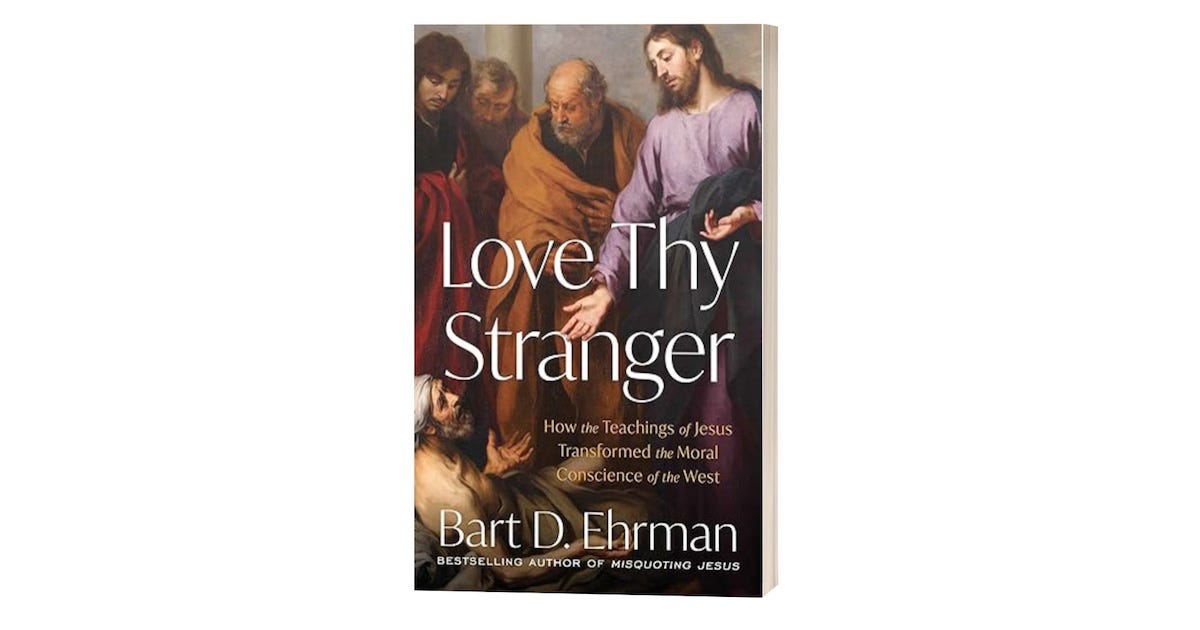
We are pleased to announce that “Stranger Danger: How Bart Ehrman’s Latest Unmasks the History of Altruism,” Ben Bayer’s review of Bart Ehrman’s Love Thy Stranger, has been published as the cover story of the October/November 2026 issue of Free Inquiry. You can read the opening paragraph below and the full essay at Free Inquiry.
Anyone today who cites the Bible to make moral objections to homosexuality or premarital sex becomes an easy target for a certain critical question: Why follow those passages but not the Old Testament rules permitting the sale of one’s children into slavery and condemning the act of touching pigskin?

“Anyone today who cites the Bible to make moral objections to homosexuality or premarital sex becomes an easy target for a certain critical question: Why follow those passages but not the Old Testament rules permitting the sale of one’s children into slavery and condemning the act of touching pigskin?”
I think most people who cite the Bible do so because they’re not able to articulate why they believe homosexuality (or something else) is morally wrong.
This should not be taken as a win for those of us who believe otherwise (whether or not we can do better in our defense).
I personally have no problem with any individual who believes some practice or behavior is morally objectionable. That should not change my life or the lives of people who live contrary to Biblical teachings. Whatever happened to people living where their values are accepted or, if not, moving to another community that will accept them.
If my history is correct, Rhode Island was such a place: established as a refuge for people fleeing religious persecution in other colonies. Roger Williams founded the first settlement of Providence in 1836 (historically 1636) after he was banished from the Massachusetts Bay Colony for speaking out against mandatory church attendance and the mixing of church and state.
In the modern era, San Francisco became a major global safe haven for the LGBTQ+ community, particularly during the mid-to-late 20th century.
Much like Rhode Island was founded by people who refused to conform to the strict religious rules of neighboring colonies, San Francisco became a place where people who were legally, socially, and physically persecuted in the rest of the United States could build their own self-governing, supportive community.
I don’t think any of those people should have to justify their beliefs for or against some way of life. They just need to respect individual rights and find like-minded people.
We all don’t have to agree on what is morally right or wrong, but we must respect each other’s choices.