
 Audra Hilse
Howard Roark sues Dominique Francon. Dominique plays an instrumental role in shutting down Roark’s Aquitania Hotel project. Peter Keating allows his wife Dominique to model nude for a sculpture. Roark loses everything to Hopton Stoddard.
If these events sound strange and unfamiliar to readers of The Fountainhead, that is understandable; none of them occur in Ayn Rand’s novel. What readers may not know is that these are all events that Rand was considering for Part II of the novel in early outlines of the story. In fact, she considered three different versions of the later events of Part II, with the third, final version, as the one that we know from the published book.
Interestingly, we do not find this many different outlines for any other single part of The Fountainhead in Rand’s papers, suggesting there was something especially challenging in the planning of Part II. In future articles, I will review changes to other parts of the book. But a review of these early outlines from Part II, and some short additional notes related to them, reveals the drastic changes that Rand was willing to make to her own masterwork in order to perfect it. She had high standards for literary work, and made the effort to integrate theme, plot, and characterization in her novels, including The Fountainhead.
The Blueprints
In The Fountainhead as published, Part II opens with Dominique Francon meeting and having her first antagonistic encounters with Roark in Connecticut where he works in her family’s granite quarry. She returns to New York without knowing who he is, learning his identity only when they are formally introduced in public at a party.
Realizing that the man she has fallen in love with is not an anonymous quarry worker but a brilliant architect whose name is becoming known, Dominique sets out to try and prevent Roark from creating more of his work for a world that — as she believes — doesn’t deserve it. She wins architectural commissions away from Roark and writes negative-sounding articles about him in her newspaper column, all while carrying on a love affair with him in secret. Dominique agrees, at Roark’s request, to model for the Stoddard Temple statue. After Roark’s loss at the following Stoddard trial, Dominique fulfills a promise from earlier in the story, and marries Peter Keating to punish herself, ending her affair with Roark.
What we know from Ayn Rand’s “blueprints” for the novel, her outlines, is that this was not her original plan for this part of the story. Rand considered two other possibilities before deciding on this one.
Version 1: The Libel Lawsuit
Version One of the later Part II events comes from an outline dated June 1938, one of a set of detailed outlines for all four parts of the novel that Rand made just before she started writing the first draft.1 The early events of Part II are like the published book up to the point when Dominique learns that Roark is an architect and decides to prevent him from getting commissions.
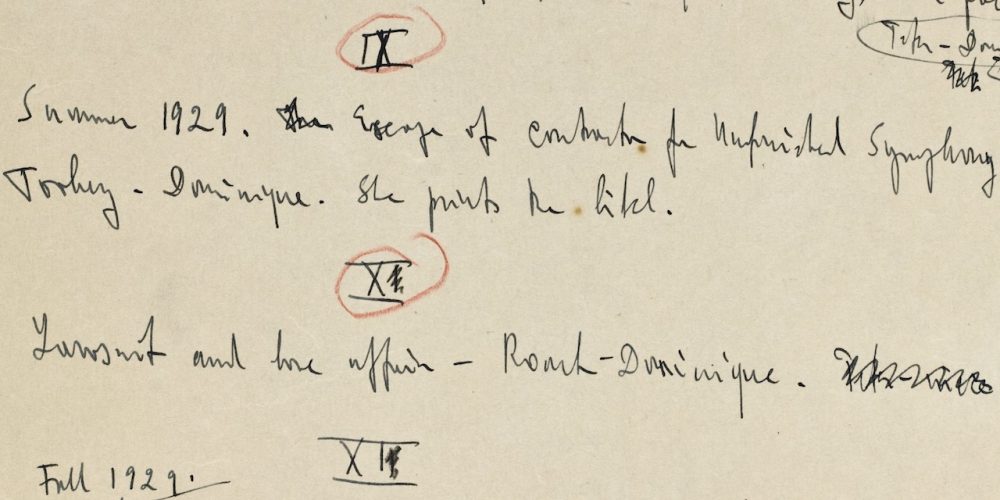
At this point in Version One, however, events proceed quite differently from the final novel. Roark gets the commission for the Aquitania Hotel, but something goes wrong; the outline states that the contractor working on the hotel project “escapes.” Rand does not include additional details in the outline, but the implication is that the contractor committed some crime, perhaps fraud or embezzlement, and gets away with it. This gives Dominique an opening in her campaign against Roark. Manipulated and encouraged by Ellsworth Toohey, she writes and prints a libelous article about Roark in her column.
The libelous article about Roark forces him to sue Dominique. Rand does not describe the article anywhere but notes that “unsafety of construction” would be the type of libel that would really be “dangerous” for an architect’s career. Her next point in this outline is “lawsuit and love affair,” setting up the dramatic tension of Roark and Dominique continuing their affair in private even as this lawsuit plays out between them in public.
Roark wins the lawsuit against Dominique, proving that her article about him and the Aquitania project was libelous. However, the article had its intended effect despite Roark’s efforts, and work on the Aquitania Hotel halts the day after his victory in court. At this point in Version One, Dominique marries Peter Keating. This follows up on a promise she made to Keating in Part I of the novel, that if she ever wanted to “punish [herself] for something terrible,” that she would marry him (Part I, Chapter 14).
Roark’s Stoddard Temple commission and the subsequent trial then come after Dominque’s marriage to Keating (a reversal of the timing in the final novel). The outline conveys interesting points in relation to this sequence of events as well. Rand planned a scene in which Roark would visit Dominique and Keating in their married home to convince them that Dominique should model for the statue he envisioned for the Stoddard Temple. Evidently Roark was to succeed at this, though, unfortunately, Rand left no notes or drafts indicating how she planned that conversation would go.
Rand also planned for a different outcome in Roark’s loss of the Stoddard trial. In Version One, unlike in the final novel, Roark was to lose everything, not just money but also his office and apartment. Rand saw this version of Part II closing with Roark forced to live in the uncompleted Aquitania Hotel building.
Version 2: The Shareholder Vote
Not quite two years later, in March 1940, Rand wrote a different outline for this later section of Part II.2 The early chapters, up through Roark and Dominique’s formal introduction at Kiki Holcombe’s party, are unchanged, but events once again differ from there.
Rand had already decided that the libel lawsuit between Roark and Dominique did not work; as dramatic as it was, something about it wasn’t right for the story. Instead, she envisioned a greater role for Dominique in events surrounding the cancellation of the Aquitania Hotel project. This began with a public campaign against Roark’s design of the Aquitania Hotel building. The outline does not indicate whether this is a spontaneous outcry, or if one of the characters (such as Toohey or Dominique) is fomenting it in some way.
Although Dominique was unable to prevent Roark from getting the Aquitania commission, she sees an opportunity as this campaign against the hotel progresses. This time, she successfully influences one of the shareholders funding the Aquitania project. As both construction and the public campaign against the hotel progress, the shareholders must eventually come together and vote: will they continue trying to build the hotel despite this public opposition? The outline implies that the shares Dominique has influence over are the deciding factor in the vote being “No.”
Work on the Aquitania halts with construction only partly complete, making it Roark’s “Unfinished Symphony” in this second version as well. This is not quite the tipping point for Dominique’s marriage to Peter Keating in Version Two; instead, just after the construction halts, Dominique visits the site of the incomplete hotel and sees an example of disgusting human behavior or advertising (Rand was undecided on the specifics). It is witnessing this reaction to Roark’s work and knowing that such reactions will continue that pushes Dominique into marrying Keating. Then, as in Version One, the Stoddard Temple and trial proceed after the marriage, once again including Roark’s visit to Keating and Dominique, and Roark’s losing everything in his courtroom loss.
Version 3 (the Close-to-Final Version): The Stoddard Temple
Finally, we come to Rand’s third outline for Part II, which is dated December 1941.3 She created this outline just after signing a contract with a publisher, Bobbs-Merrill, to publish The Fountainhead. Her advance from the publisher allowed her to finish writing the book. With that goal in mind, and only a year to do it, Rand reviewed her existing outlines and made what she thought were needed changes.
Version Three contains some minor differences (later crossed out) from the final novel, including the “escape” of the corrupt Aquitania contractor following an unspecified crime. Aside from that, this Version Three outline gives essentially the sequence of events for Part II that we read in The Fountainhead.
After their formal introduction at the Holcombe party, Dominique works to win commissions away from Roark even as they continue their love affair in private. She writes many articles in her column about Roark, using clever wording that simultaneously praises and criticizes his architecture (his architecture is too good to share with people who do not deserve it), but none of these articles are libelous.
Roark gets the Aquitania Hotel commission, and work does halt partway through construction, but due primarily to fallout from the 1929 stock market crash, not due to any interference on Dominique’s part.
Thus, in Version Three, Dominique is not directly involved in any of Roark’s projects until she agrees to model for the sculpture in the Stoddard Temple at Roark’s request.
Due to Toohey’s manipulations behind the scenes, Roark is sued over the Stoddard Temple after the building is completed. Toohey also provokes public outrage against the building, aiming to further damage Roark. The lawsuit goes to trial, which Roark loses. Notably, in this version of events, he does not lose everything; he keeps both his firm and his apartment and does not have to live in the uncompleted Aquitania Hotel building.
Dominique marries Peter Keating after Roark’s loss in the Stoddard trial.
In summary: Version One contains the libel lawsuit between Roark and Dominique, Dominique’s marriage to Keating immediately after Roark wins that lawsuit, and Roark losing everything in the Stoddard trial. Version Two drops the libel lawsuit, replacing it with a campaign against the Aquitania Hotel, Dominique’s interference in a subsequent shareholder vote to stop the project, and with her marriage to Keating after the shareholder vote, but retains Roark’s loss of everything in the Stoddard trial. Version Three gives the events as we read them in the novel, dropping the Aquitania campaign and shareholder vote, shifting Dominique’s marriage to Keating to follow the Stoddard Temple and trial, and having Roark lose money in the Stoddard trial but not his office or apartment.
What the Blueprints Tell Us
The changes between these three different versions of events for Part II of The Fountainhead are drastic. Why did Ayn Rand make them?
Rand did not leave any explicit comments on these changes, and the only documentary evidence we have of Versions One and Two comes from the relevant outlines and some brief notes. Thus, we cannot know her reasons for the changes.
What we do know for certain is that Ayn Rand had very high standards for what constituted great literature, which she spoke and wrote about extensively later in her life (The Romantic Manifesto, The Art of Fiction). Her planning material for The Fountainhead provides evidence of the concrete ways that Rand held herself to those very high standards. That a certain part of the story had a dramatic and interesting sequence of events and actions was not sufficient for her — they had to be the right events and actions to achieve the tight integration of theme, plot, and characterization that Rand considered necessary for a great novel.
What we see in her planning material, both about Part II and about other parts of the novel, is that Rand kept thinking about and working on the story until she achieved that integration — not that it came automatically to her. Because Rand didn’t settle for something “good enough,” she achieved a great novel in The Fountainhead that not only became a bestseller in her lifetime but has remained one even decades after Rand passed away.
To view most of the outlines and notes discussed in this article, please visit the online exhibit Blueprints for The Fountainhead.
Image Credit: © Leonard Peikoff (Ayn Rand Archives)
Do you have a comment or question?
Endnotes
- Ayn Rand, “First Draft of Chapter Plan,” June 5, 1938, Ayn Rand Archives, Ayn Rand Papers, 097_56A_002.
- Ayn Rand, “Revised Schedule of Chapters,” March 4, 1940, Ayn Rand Archives, Ayn Rand Papers, 167_03B_004; Rand, “Continued Schedule of Chapters,” March 6, 1940, 167_03B_006.
- Ayn Rand, “Partial Outline of Chapters,” December 17, 1941, Ayn Rand Archives, Ayn Rand Papers, 097_56B_020.
 NI Staff
 Agustina Vergara Cid
 Brandon Lisi