


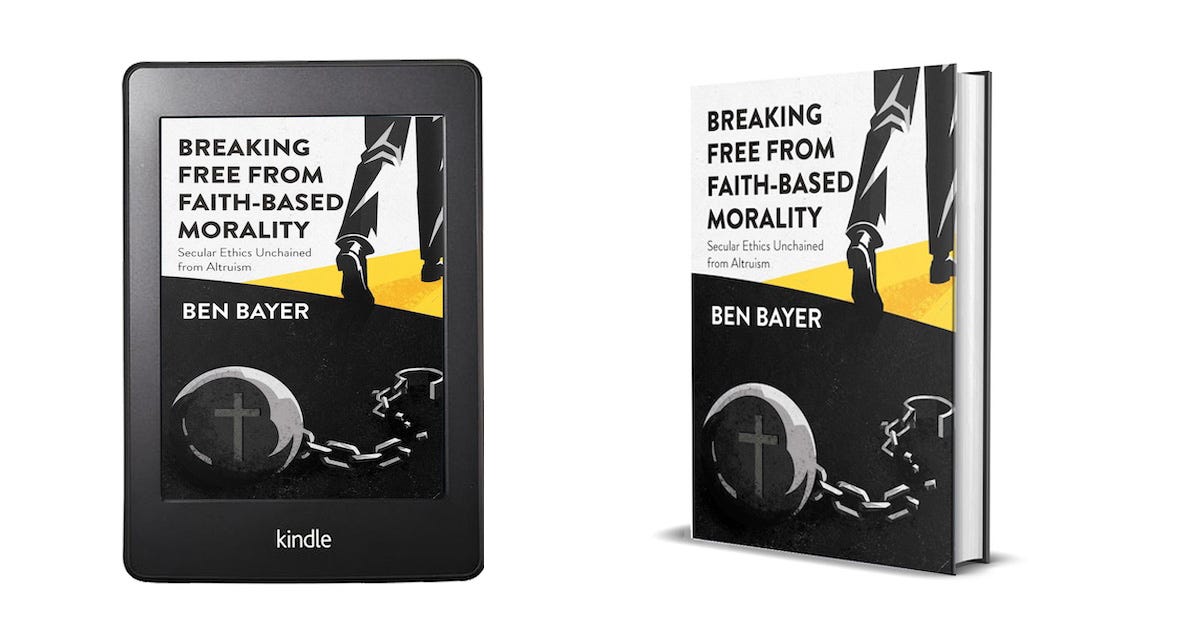
On December 1, ARU Press will publish ARI senior fellow Ben Bayer’s Breaking Free from Faith-Based Morality. The book is a collection of essays published in New Ideal on the theme that the morality of altruism is essentially religious and that a truly scientific ethics must embrace an ethics of rational self-interest. You can pre-order the book through Amazon here. To introduce readers to the book, we’re happy to publish its preface. (Modest revisions were added here on October 16, 2026.)
Religious belief dies hard. On some level, most atheists know this. But do they know what it really takes to give up all of the holdovers of religious belief?
I first abandoned religion around the age of seventeen. I did it by grappling with skeptical questions from friends and by befriending peers from different faiths, who made me wonder why the Catholicism I’d absorbed from my parents was so special.
But even after I consciously rejected my religious beliefs as unfounded and irrational, their influence endured. It took the better part of a year to get over the disappointment of no longer believing in eternal life. And in one memorable experience, I was terrified at my first viewing of The Exorcist because, even though I was nearly an atheist, I hadn’t fully shaken the idea that demons might still be real.
The power of the remnants of religious cosmology paled in comparison to that of religious morality. Part of how I came to reject religion was by taking religious sexual morality very seriously, but realizing how it came at the expense of personal relationships and happiness. So it would take years, if not a decade, to shake the Catholic guilt I’d come to associate with sex.
Leaving the church was easier than breaking free from its morality. I’m sure I’m not the only one to experience or recognize this.
This book is about how Western secular culture remains in the grip of religious morality. That’s especially so because religious morality is broader than just sexual prudishness and misogyny. And its greater scope of concerns is just as destructive.
The reason to note this predicament is not merely sociological. It’s to urge that we break this grip. Even as I first began to doubt my religion, I never lost sight of the urgent need for rational norms to guide my choices. This book clears the ground of religious relics to show how we can build a new, secular morality.
What drives the culture-wide religious fervor?
In this preface to my fuller argument, I want to point briefly to just the tip of the religious iceberg that still keeps secular culture’s moral progress frozen in time. We see the tip in some recent political controversies. I explore the rest of the iceberg in the book.
Everyone knows that the American conservative movement is awash in Christian religiosity, with the result that Roe v. Wade was overturned and the Ten Commandments are back up in classrooms. But the religious upheaval is not just on the American “right.”
Recently, two “progressive” Democratic politicians have worn their Christianity on their sleeve: Senator Raphael Warnock of Georgia and James Talarico, a candidate for the Senate from Texas. Both went to divinity school. Warnock is still a practicing minister.
And the “religious left” is broader than the overtly Christian Democrats. We see another kind of religiosity in the practices of the “woke” egalitarian movement, which many have likened to a new religion. Describing the irrational dogmatism of this movement, John McWhorter notes their articles of faith: racism is the indelible original sin driving every social problem, anyone who offers evidence of progress in combating racism is “fragile” or a heretic, and an anointed “elect” of “woke” saints should instead lead us in service to racism’s victims.1
Jason Arday, the late Cambridge sociology professor, leveraged his (likely fabricated) status as a victim to become one of the “elect” saints. But what’s most revealing about his case isn’t what got him hired, but the reaction within academic culture once the evidence against him mounted. It was not taken as a “teaching moment” to reflect on whether university DEI missions incentivized this behavior at the expense of academic rigor. Instead, far too many refused to consider the evidence, defended Arday without real grounds, smeared all of his critics as racists, and even tried to elevate him into a kind of martyr to the cause of the “woke” articles of faith.2
We see the same religiosity in green activists, like the members of Extinction Rebellion who embrace faith in an imminent environmental apocalypse and anathematize every high-tech form of alternative energy like carbon-free nuclear power.3 Their saint is Greta Thunberg — who became a child prophet at fifteen in spite of lacking any expertise. Indeed, having gone on strike against her own education was part of her appeal. She regularly effaces herself by refusing to travel by plane and by submitting to arrest at green protests. And her movement urges imitation of the green saints, shaming anyone unwilling to give up modern standards of living.
And then there is the recent upsurge in support for democratic socialism. Its followers twist definitions to maintain their articles of faith: that real socialism has never been tried, and that their group of saints will somehow have better luck this time avoiding economic destruction, political oppression, and mass death. Instead, they’ll lead us to a magical heaven on earth in which each of us puts in minimal time at work, lives without debt or insurance, and enjoys abundant leisure time.4
What drives this religious fervor among activists who are not known for their church attendance? It’s here that we can see how religious morality exerts its pull.
In his account of the religiosity of the “woke” movement, McWhorter brushes up against the central issue. “Elect ideology stipulates that one’s central moral duty is to battle racism and the racist” (my emphasis).5 Our moral duty, in their view, is to submit not only by “taking a knee” to victims of racism (real or alleged). Job candidates are also to give up jobs for which they are qualified, and hiring committees are to give up their intellectual standards to elevate unqualified candidates merely on the grounds of their alleged status as victims. McWhorter notes that such submission — especially submitting our minds to the “woke” articles of faith — “is all very Abrahamic as religion goes.6
Each of the other activist movements demands similar Abrahamic submission. Whether we are to sacrifice economic prosperity to Gaia’s pristine wilderness or economic freedom and property rights to the classless society of the future, the activists demand we sacrifice ourselves and our values on the altar of the allegedly “higher” end of serving some Other. This moral outlook enjoins the virtue of humble self-sacrifice and condemns heretics who commit the sin of prideful self-esteem. Even though many of the modern activists think of themselves as secular, they draw these core doctrines from none other than Judeo-Christian religion — whether they know it or not.
More rational thinkers in the secular camp may agree there is something wrong with the religious fervor that motivates these activists, but concede that there is something noble about their (professed) ends. They may say that the Bible verses quoted by Talarico and Warnock are from a primitive mindset, but they motivate people to uplift the poor. But how do these thinkers know that their conception of the noble end is noble and not itself a product of that same primitive, religious mindset?
I think secular altruism — the doctrine that morality consists in selfless service to others — is in fact such a product, a holdover from Christianity’s two-thousand-year monopoly over our thinking about right and wrong, good and evil.
How the book diagnoses the fervor, and its antidote
This book demonstrates how not only the activist left but also the broader secular camp in American culture has uncritically absorbed the essence of Judeo-Christian morality and never seriously considered a rational alternative. This runs the gamut from secular philosophers to the atheist and effective altruist movements. And it shows how this altruistic morality is responsible for the irrational fervor in American political culture, and for even many rational people’s unwillingness to stand up against it.
The most rational, pro-science secular thinkers, when commenting on questions of morality, are eager to point to the moral theories developed by nominally secular philosophers as alternatives to religious morality. In the first part of the book, I examine a cross section of these theorists, philosophers such as Immanuel Kant, Henry Sidgwick, John Rawls, Derek Parfit, and Peter Singer, who posit one or another view about how morality demands impartial, disinterested action. I examine their approach to how we know ethical principles (chapter 1) and the nature of moral value (chapter 2), and identify the Judeo-Christian religious core of these approaches (a faith-based epistemology with its attendant supernaturalistic metaphysics).
The implication is not that religious morality is unavoidable or that morality is dispensable. On the contrary, I show that Christianity derailed the first nonreligious attempt in history to offer rational guidance for living, and that it has monopolized the conscience of moral thinkers ever since (chapter 3). The first attempt — the project of classical Greek philosophy — was also notably unconcerned with selfless service to the needy. This history helps demonstrate not only Christianity’s unique role in crafting modern altruism but also that the origin of altruism is infused with all the worst forms of irrationality and resentment of worldly knowledge and happiness that animate religious mysticism (chapter 4).
In the second part of the book, I show how the monopoly of religious morality is so extensive that it has penetrated even the most secular sectors of our culture: the atheist movement (chapter 5), the leading secular defenders of science (chapter 6), and the effective altruist movement that influences so much of the technology industry today (chapter 7). In each case, the influence of religious morality undermines the advocates of science and reason in their efforts to win the “culture war” and imperils their optimism about the power of science to solve the world’s technological problems.
In the final part of the book, I return to questions of ethical theory with a view to building a positive, rational alternative. I first show (in chapter 8) how a healthy approach to ethics needs to focus on answering everyday life questions faced by ordinary people, not niche puzzles about artificial dilemmas between people. I then argue (in chapter 9) that the focus on artificial dilemmas has been encouraged by an overly narrow conception of the subject of ethics that confines it to questions about interpersonal obligations rather than to questions of basic choices of value and virtue that guide the big questions about how to live life, whether they concern other people or not.
In the final chapter (chapter 10), I show how — once we clear the ground of confusions instilled by religious approaches to morality — we can build a fully secular ethical theory, using the values of science itself as our basic building blocks. This chapter in particular draws on the moral philosophy of Ayn Rand, whom I take to be the leading defender of Enlightenment values. Her critique of altruism and her positive alternative are behind the scenes of every chapter in the book.
Together, the essays collected here demonstrate the book’s theme, though they were not all originally drafted with the present sequence in mind. They were originally written as separate articles, mostly for New Ideal, the journal of the Ayn Rand Institute. (Chapter 4 was originally published in Free Inquiry and subsequently republished in New Ideal.) To integrate them into the structure of this book, I have revised them all to some extent to make them read better. (Chapters 7 and 9 in particular have been significantly revised from the originals.)
Rejecting the final god
I’ve mentioned that after I abandoned religion, religious sexual morality still kept its claws in my psychology for years. The same was true of Christian altruism, even after Rand’s influence led me to disavow it as well. Even thirty years after abandoning religion, I still at times fear the disapproval of altruists and feel distant twinges of guilt for being selfish. But when I reflect more consciously, these feelings disappear.
Consider: if even I, a vocal advocate for Ayn Rand’s conception of rational selfishness, occasionally feel these distant twinges, what must be true for other secular people who’ve never scrutinized the origin of their moral beliefs? No matter their atheist credentials, they are likely to feel in spades the fear and guilt induced by altruism. That’s because they’ve never faced the fact that while they’ve rejected so many other doctrines of their childhood preachers, altruism is the one they’ve never been willing to let go of.
Richard Dawkins has popularized the idea that most people have no trouble denying the existence of gods for which there is no evidence. Most reject the existence of a plethora of polytheistic gods. He urges them to “go one god further.”7 This book directs a similar challenge to atheists to reject a final baseless posit of religion: the worship of self-sacrifice.
It’s time for the secular world to fully grow up and break free from the bonds of religious morality. This is the only path to self-conscious, rational progress in the field of morality, and to the civilizational progress it will enable.
John McWhorter, Woke Racism: How a New Religion Has Betrayed Black America (New York: Portfolio/Penguin, 2021), 25–50. See my article on McWhorter’s book, “The Old Morality of the New Religions,” New Ideal, January 4, 2023.
See Helen Lewis, “The Jason Arday Truthers,” The Atlantic, August 26, 2026.
See Michael Shellenberger, “Why Climate Activists Will Go Nuclear — Or Go Extinct,” Quillette, June 25, 2020. The environmental movement generally has deeply Christian historical roots. We can’t imagine its critique of materialism without its origin in the self-effacing moralism of Thoreau and Emerson, who saw nature as a means of transcending the world in favor of a higher dimension of existence. See Donald Worster, Nature’s Economy: A History of Ecological Ideas, 2nd ed. (Cambridge: Cambridge University Press, 1994), 100–106.
Democratic Socialists of America, “Workers Deserve More!” accessed September 2, 2026. See my article “The Dishonesty of ‘Real Socialism Has Never Been Tried’,” New Ideal, August 19, 2020.
Ibid., 48.
Ibid., 27.
Richard Dawkins, The God Delusion (New York: Houghton Mifflin, 2006), 53.

What a gem this book is going to be, and so needed. I found Ayn Rand at 42. Even now at 72, in some situations my emotional attachment to altruism immediately kicks in and I have to take a moment to think through what is really going on. I was an atheist since my teens, but always still superficially thought selfishness was a vice until a very smart lady convinced me of "The Virtue of Selfisness". Can't wait for the book.
Thanks Ben!
Great preface. Looking forward to reading and the discussions on podcasts.
Next Up
How Religious Epistemology and Religious Metaphysics trappings linger and dominate.
Although you did address it a bit with the guilt and shame around sex...that wasn't altruism.
Religious Epistemology - Feeling, Believing, Imagining, "trusting your gut" "feel it in your heart"
Religious Metaphysics - Magical lands of unseen forces for good and evil. "manifest" "heaven"
Religious Epistemology + Religious Metaphysics = Altruism (religious ethics/morality)
Mamas don't let your babies be raised religious.